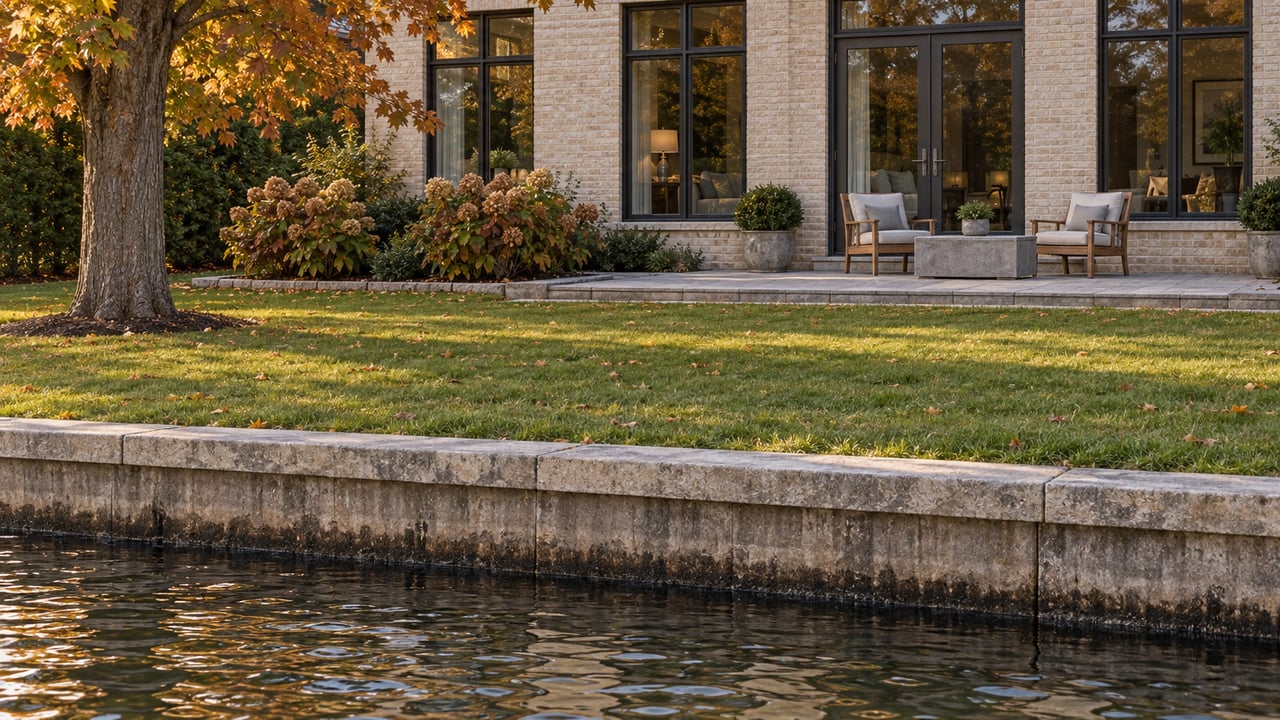
Tony Wheaton told the Detroit Free Press in late September that getting his 44-foot cabin cruiser from the Campau Bay shoreline out to open water can take 10 to 15 minutes at about 5 mph, because of the muck along that stretch of Harrison Township shore. Campau Bay is a sheltered bay off South River Road near the mouth of the Clinton River. On a listing sheet, that kind of protected water usually counts as a selling point.
The muck builds up where waves are weakest. If you're comparing waterfront homes here, the calm water you'd pay extra for is often the same water where this algae piles up.
Why calm water collects it
The material is an algae called Microseira wollei, usually shortened to M. wollei. According to Macomb County Public Works, it grows on the lakebed as far as 1.5 miles offshore. Wind and waves knock it loose, it floats to the surface, and it washes up along parts of the shoreline. A 2024 summary of the U.S. Army Corps of Engineers research describes dense growth in small coves and along shorelines, sometimes thick enough to make docks and recreation areas unusable. Waves and currents carry the mats to shore.
Harrison Township gets more of it than most places. C&G Newspapers reported in February 2026 that the Corps' two-year study found the muck starts on the lake bottom, and that wind direction and flow from the channels push it toward Harrison Township and nearby communities. State Rep. Alicia St. Germaine, who represents the township, has said the muck is linked to sewage and combined sewer overflows coming down the Clinton River. She has also said it got worse in the past couple of years while nobody was managing it.
The county used the same reasoning when it picked sites for a cleanup trial. Its three locations were chosen because "the geometry of the shore has less wave action than straight sections." In plain terms, a cove, canal or enclosed marina keeps out the chop that would otherwise move the algae along.
Where it has been reported by name
Local reporting from 2025 and 2026 names specific places along the Harrison Township shore:
- Campau Bay, off South River Road. It's a county trial site, and it's where Wheaton described the slow trip out. In November 2025, Freedom Boat Club owner Steve Dobreff showed WDET a boat launch at Campau Bay and said a nearby dock was gone.
- Hidden Cove Condominiums marina, south of the Clinton River Spillway. This is the second Harrison Township trial site.
- Lakeshore and the Archer canal. At a February 2026 presentation hosted at Huron Pointe Yacht Club, Wheaton, the club's commodore, said the muck was noticeable there. He said residents of the shallow Archer canal had been having it sucked out for years.
- The Michigan DNR launch in Harrison Township. St. Germaine said the muck makes it hard to launch boats there and get them out of the harbor.
- Near L'anse Creuse Bay. Dobreff said the muck had made the water there unswimmable.
Residents have also described a rotten-egg smell bad enough that they stayed indoors and kept windows shut, according to St. Germaine's account in the same C&G report. For a waterfront home, that changes how much use you actually get from the dock, the boat, the patio and the windows facing the water.
Why an October showing can miss it
Season matters a lot for this. According to the 2024 Corps-linked research summary, M. wollei growth on Lake St. Clair likely slows in winter and peaks in summer. Today is October 9. A buyer touring a canal-front home this fall or winter may be looking at the seawall at the slowest point of the algae's year. By the next summer, the same shoreline may look quite different.
That doesn't make fall a bad time to buy here. It means the photos and the showing reflect one season. Summer photos of the property, a talk with neighbors on the same canal, or a look at the water from a boat can show what a November walk-through won't.
What the disclosure form asks, and what it leaves out
Michigan's Seller Disclosure Statement is the statutory form most residential sellers complete. Its text is set out in MCL 565.957. The form asks whether well water has been tested, but none of its property-condition questions mentions shoreline algae, muck or the condition of the lake out front. Here is how the closest questions line up:
| Form question | What it lists | Does it mention algae or muck? |
|---|---|---|
| Environmental problems | Asbestos, radon, formaldehyde, lead paint, fuel or chemical storage tanks, contaminated soil | No |
| Water and drainage | Flood insurance, basement or crawl-space water, settling, flooding, drainage, grading | No |
| Shared features | Features shared with neighbors whose use or maintenance may affect the property | No |
| Easements and associations | Encroachments, easements, common areas, homeowners' association authority | No |
The form also says the disclosures are based on the seller's knowledge when signing. It states that the disclosure is not a warranty and does not replace inspections. A separate section, MCL 565.955, covers what happens with errors or omissions outside the seller's personal knowledge. So the form is built around what the seller knows about the house and lot. Seasonal algae drifting in from a lakebed a mile offshore has no question of its own.
The shared-features and association questions are the most useful ones here. If a canal's residents have arranged removal together, or a condominium association handles its marina, those questions are where it may come up. A buyer can also ask directly. Wheaton said Archer canal residents had been having muck sucked out for years, so on some stretches of water, removal is already part of owning the shoreline.
What owners are allowed to do today
Under current rules, a shoreline owner has limited options. A Michigan House release from April 2025 said hand tools like rakes were the only cleanup tools owners could use without an EGLE permit. According to EGLE's guidance on aquatic nuisance control, chemical treatment below the ordinary high-water mark on Lake St. Clair always requires a permit. Mechanical and physical work goes through EGLE's district offices, and most work that alters Great Lakes coastal areas also needs a U.S. Army Corps of Engineers permit.
A bill would change that, but it has stalled. House Bill 4314 would let owners use mechanical equipment to remove free-floating debris and vegetation without a state permit, as long as the work doesn't disturb the lakebed or involve dredging. It passed the House 87 to 11 on December 10, 2025. On December 16, 2025, the Senate sent it to its Energy and Environment Committee, and the bill's official history shows no action since.
The trial, and what it is designed to learn
In July 2026, Macomb County Public Works announced a three-year field trial paid for by an $800,000 state earmark sponsored by St. Germaine and State Sen. Kevin Hertel. Dean Marine & Excavating and Sediment Lakes Aquatic Management were chosen to do the removal. Their work was "tentatively expected to start in September," pending permit review by EGLE and the Army Corps. The Free Press story, updated September 30, ran under the headline "permits in the works." We found no public report confirming that removal has started at Campau Bay or Hidden Cove as of early October 2026.
The trial is designed as a study. Crews will test removal methods, measure how long wind and waves take to bring offshore algae back to shore, and clear a separate section of the Campau Bay lakebed to watch for regrowth. Contractor bids put removal at the 10 worst locations at more than $3.3 million. Public Works Commissioner Candice S. Miller said the targeted removal "is not a one-and-done solution." For a buyer, the trial means more data on the problem in the coming years. It doesn't mean a cleaner shoreline next summer.
Questions to ask before you write an offer
- Does the home sit on a cove, canal, bay or enclosed marina, or on straight, open shoreline?
- Are there summer photos of the seawall and the water out front?
- Have the canal residents or the association paid for removal before, and how was the cost split?
- Does the association's budget or meeting record mention algae or muck?
- How long does it take to get from the dock to open water in late summer?
A Few Direct Questions
Is every Harrison Township waterfront home affected? No. The reported problem areas are specific places, and the county describes deposits along "parts of the shoreline," mostly where wave action is weaker.
Can an owner rake it out? According to the 2025 House release, hand-operated tools like rakes could be used without an EGLE permit. Mechanical removal is a different matter, and HB 4314 hasn't changed that yet.
Will the trial clear the canal behind a given house? The trial covers three named sites, two of them in Harrison Township, and runs for three years.
If you own on a Harrison Township canal or cove and are thinking about selling, The Zibkowski Team can help you plan the timing and the shoreline photography so buyers get an accurate picture of the water out front. Request a Free Home Valuation and we'll go over how your stretch of shoreline compares with recent sales.
This article is general information, not legal, tax or financial advice. Consult a qualified professional about your situation.