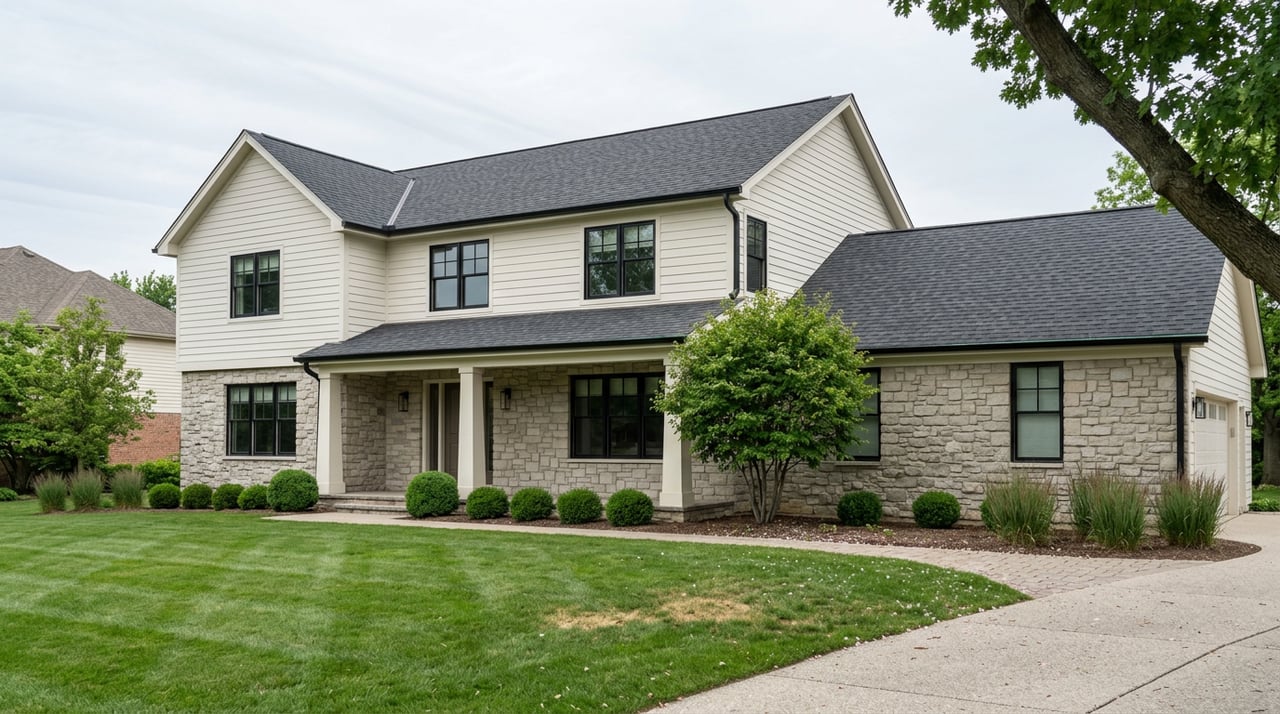
Two colonials sit across the street from each other in a Rochester Hills subdivision. Same builder era, same lot size, same "Rochester Hills, MI" address on the listing sheet. One family's kids will walk into Rochester Adams High School. The other family's kids are zoned for Avondale High, a district building located in neighboring Auburn Hills. Neither buyer chose this. The street itself is the boundary line.
This isn't a rare edge case you'll never encounter. It's baked into how Rochester Hills was assembled, and it shows up on tax bills every year whether a buyer noticed it during the showing or not.
A City Built From Pieces That Never Fully Matched
Rochester Hills wasn't always Rochester Hills. It was Avon Township until 1984, when residents voted to incorporate rather than let the City of Rochester annex them piece by piece, which had already happened once in 1974 when Rochester took 2.2 square miles of the township. The two communities share a name, a border, and a lot of institutional history, but they have always been separate municipalities with separate tax rolls. That's the first mismatch buyers run into: "Rochester" and "Rochester Hills" are not the same city, and a listing that says one doesn't guarantee the other isn't next door.
The second mismatch runs deeper, and it's the one that actually costs money. Rochester Hills sits inside two different school districts, and the line between them doesn't follow the city boundary, a major road, or anything a buyer would notice driving through. Most of the city is served by Rochester Community Schools. A pocket in the southwest, closer to the Auburn Hills line, falls into Avondale School District instead. Students in that pocket are zoned to Deerfield Elementary, which is inside Rochester Hills, but depending on exactly where they live they might instead be zoned to Auburn Elementary in Auburn Hills or Woodland Elementary in Troy. From there, all Avondale-zoned students in Rochester Hills funnel into Avondale Middle School, which sits inside the city, and then Avondale High School, which does not.
None of this is visible from a street address. It's visible on a school boundary map, and only if you go looking for one.
The Number That Actually Moves
Here's why the district line matters more than the city line for anyone comparing homes on price.
Michigan school millage is layered on top of a flat municipal rate, and in Rochester Hills that municipal layer is consistent everywhere in the city, currently around 11.27 mills for city operations regardless of which subdivision you're in. What varies is the school portion, and it varies by a wide enough margin to change your annual number by four figures.
| School District | Approx. Primary-Residence Millage (2025-2026) | Estimated Annual Tax on a $450,000 Home* |
|---|---|---|
| Rochester Community Schools | roughly 30.0 to 30.8 mills | roughly $6,750 to $6,930 |
| Avondale School District | roughly 34.9 to 36.0 mills | roughly $7,850 to $8,100 |
*Estimate uses a taxable value near $225,000, the approximate State Equalized Value on a $450,000 purchase under Michigan's convention that SEV runs about half of market value.
That's a gap of roughly $1,100 to $1,300 a year between two houses that could sit on the same block, both carrying the same city name and the same purchase price. Over a ten-year hold, that's more than the cost of a new roof, and it's a number that never shows up in the headline "Rochester Hills median price" you'll see on a portal.
The Zip Code Doesn't Help Either
If checking the school district feels like enough due diligence, there's a third layer worth knowing about. Rochester Hills' zip codes don't line up cleanly with the city limits either. Zip code 48307 is officially assigned to "Rochester, MI" by the postal service, yet its actual footprint reaches into Rochester Hills near downtown Rochester and Auburn Road. A listing with a "Rochester, MI 48307" mailing address can be sitting entirely inside Rochester Hills city limits, taxed by Rochester Hills, governed by Rochester Hills ordinances, with a Rochester return address on the mail.
The tax data shows the practical size of this. As of the current 2025-2026 tax year, median property tax bills inside Rochester Hills run from around $2,001 in the 48307 zip up to around $2,929 in the 48306 zip, a difference attributed to exactly the school district and local assessment variation described above. Same city. Different zip. Different real number on the bill.
Put those two effects together and you get a market where three separate labels, the city name, the mailing zip code, and the school district, can each point in a different direction on the same parcel. Buyers who anchor on any single label without checking all three are working with incomplete information, and it's the kind of gap that surfaces during a mortgage pre-approval conversation about escrowed taxes, not during the open house.
What This Means If You're Comparing Rochester Hills to Other Options
If you're cross-shopping Rochester Hills against a Rochester address, or against a Troy or Auburn Hills listing near the same border, treat the school district as its own line item, separate from the city name on the listing and separate from the zip code on the envelope. A few concrete steps before you write an offer:
- Ask for the parcel's specific school assignment, not the general area's reputation. Rochester Community Schools and the Avondale district each publish boundary maps by street segment, and a specific address can be checked against them directly rather than relied on secondhand.
- Cross-reference the assigned elementary, middle, and high school by name, since a single property can be zoned to an elementary school in one city and a high school in another.
- Run the actual millage against the purchase price, not the seller's current tax bill. Michigan uncaps taxable value the year after a sale and resets it to the new assessed value, so whatever the seller has been paying is not a reliable preview of what a buyer will owe.
- If the mailing address includes "Rochester" rather than "Rochester Hills," confirm which municipality actually taxes and governs the parcel before assuming anything about the applicable rate or district.
None of this changes whether Rochester Hills is a good fit. It changes whether the number you're comparing it against is the real one.
A Few Direct Questions
Does living in the Avondale pocket of Rochester Hills mean a lower home value? The research here doesn't support a value claim either way, and that's not a conclusion worth guessing at. What's factual is that the tax carrying cost differs, and that's a number worth building into any offer or holding-cost comparison regardless of how the two districts otherwise compare.
Is this two-district split unique to Rochester Hills? No. Auburn Hills next door is split across four separate school districts, with boundary lines that can put one side of a street in a different district than the other. Rochester Hills' two-way split is simpler by comparison, but the underlying lesson, that municipal boundaries and school boundaries are drawn independently, applies across this part of Oakland County.
Where do I actually check a specific address? Start with the district boundary maps published by Rochester Community Schools and Avondale School District, and confirm the assignment with the local assessing department if the parcel sits near a line. A listing agent should be able to point you to both.
If you're weighing a Rochester Hills purchase against something in Rochester, Troy, or Auburn Hills and want the real number instead of the headline one, that's exactly the kind of parcel-level check our team runs before any offer goes in. The Zibkowski Team works this market daily, and we're glad to pull the district and tax detail on a specific address before you spend a weekend touring it. Get a Free Home Valuation and we'll walk the numbers with you.